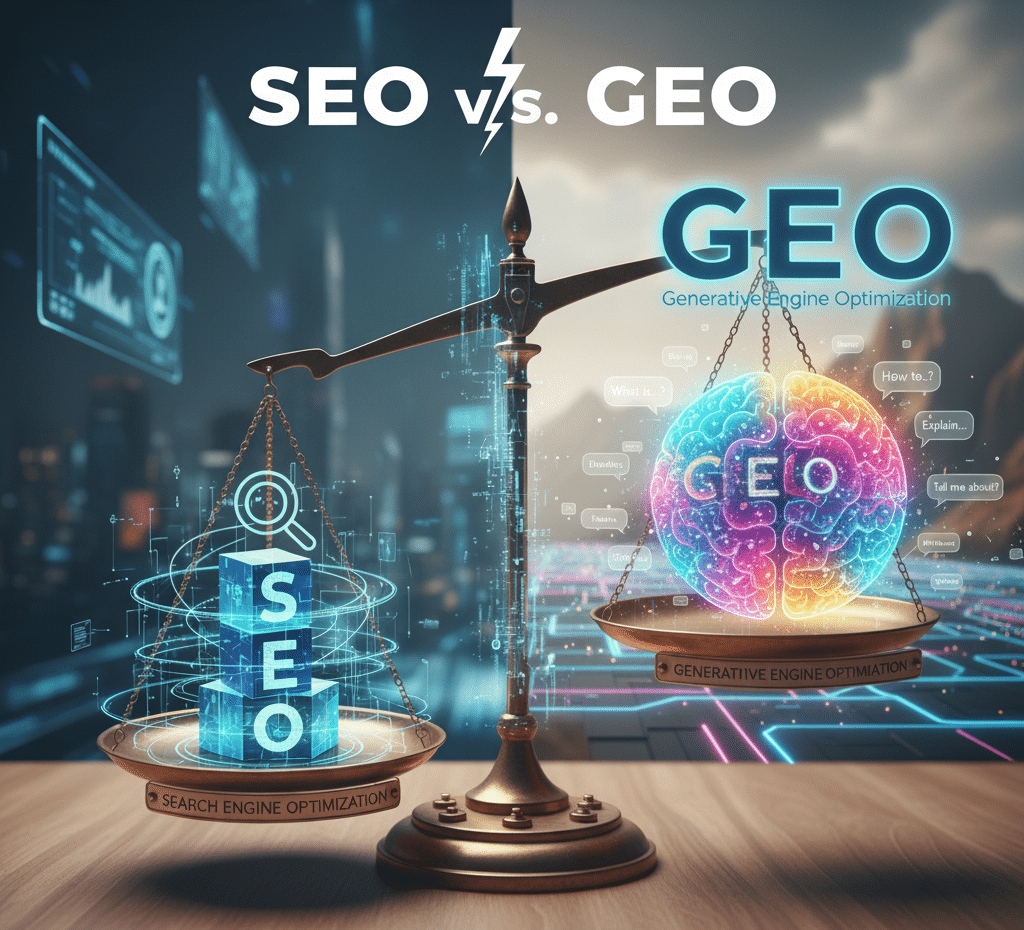

SEO vs GEO is now the front door to digital visibility for any business. Whether you are a small retailer or a multinational enterprise, how customers find you significantly impacts your revenue and growth. Two strategies dominate the landscape: Search Engine Optimization (SEO) and Geographic Optimization (GEO). These approaches overlap in purpose but differ in scope. SEO focuses on algorithms and intent-driven searches, while GEO anchors visibility to a specific location, ensuring you appear where customers live, travel to, or shop. Understanding the difference between SEO and GEO equips leaders with the clarity to allocate resources effectively.
What Is SEO and How Does It Work?
SEO enhances a website’s ranking on search engines. Every click begins with a query, and SEO ensures your content aligns with that intent. On-page strategies refine keyword placement, headings, and metadata to enhance search engine visibility. Off-page elements involve backlinks and digital credibility. Technical SEO ensures websites load quickly, function on mobile devices, and deliver accessible experiences.
The #1 organic search result on Google gets 39.8% of all clicks, and over 75% of users never go past the first page of search results (aioseo)
A 2025 industry report shows that SEO drives over 1,000% more website traffic than organic social media (searchatlas)
Case in point: A digital store selling fitness equipment can expand its national reach through SEO by ranking for terms like “adjustable dumbbells” or “home gym mats.” The business grows its visibility far beyond its local base, building authority on topics that consumers search for daily. SEO offers scalability, but it demands patience—results often take months, though the returns compound over time.
What Is GEO and Why Does It Matter?
Geographic Optimization ensures visibility aligns with location. A coffee shop in Austin does not need clicks from Boston. GEO focuses efforts on searchers most likely to visit or transact in a defined area. Seventy-nine % of customers are expected to use AI-powered search within the next year, and 70% already trust AI-generated results.
This involves tools like Google Business Profiles, localized keywords (“coffee shop near downtown Austin”), and map integrations. GEO is particularly powerful for small and medium-sized businesses. According to data, 68 percent of local searches on smartphones result in a visit to a store within 24 hours. GEO ensures businesses capitalize on that intent. Unlike SEO, which casts a wide net, GEO narrows the lens to serve high-intent, location-specific prospects.
Key Differences Between SEO vs GEO
Understanding the differences between SEO and GEO allows businesses to make informed choices.
- Scope of reach: SEO casts a broad net across states or nations. GEO narrows its focus to communities and zip codes.
- Customer intent: SEO often reaches researchers and planners. GEO captures ready-to-act customers who are near a purchase decision.
- Time to results: SEO builds gradually as search engines reward consistent content and authority. GEO delivers faster wins through map rankings and local citations.
- Resource allocation: SEO requires ongoing content and link strategies. GEO emphasizes maintaining accurate profiles, reviews, and localized ads.
For a national e-commerce platform, SEO is essential. For a neighborhood restaurant, GEO provides immediate visibility where it matters most. Most businesses benefit from both, though the balance depends on audience and goals.
How Do Businesses Use SEO Effectively?
Successful SEO strategies combine consistent execution with data-driven decisions. Leaders start with keyword research to understand what their audience searches for. They invest in content that educates and informs, not just sells. Blog posts, guides, and product pages provide direct answers to customer questions.
Technical health remains critical. Sites that take longer than three seconds to load experience a dramatic rise in abandonment rates. Structured data markup, secure HTTPS connections, and responsive design all contribute to higher rankings.
Consider a SaaS company targeting professionals nationwide. Publishing authoritative content around “best productivity tools” builds credibility, drives organic traffic, and positions the company as a thought leader. Through continuous optimization, SEO can evolve into a sustainable growth engine that attracts customers without relying solely on paid advertisements.
Recommended Read – Master how to get found in AI overviews with strategies built for results

How Do Businesses Use GEO Effectively?
GEO strategies rely on precision. A business ensures its name, address, and phone number remain consistent across directories. Reviews are encouraged and monitored, since customer feedback directly influences map pack visibility. Localized landing pages highlight services relevant to neighborhoods or districts.
Imagine a law firm in Dallas. By targeting terms like “personal injury attorney Uptown Dallas” and maintaining an active Google Business Profile, the firm secures visibility among clients searching within a few miles of its location. GEO ads reinforce the presence by targeting only the zip codes with the highest client potential. This hyper-focus minimizes wasted budget and maximizes conversion rates.
GEO success depends on accuracy and engagement. Regularly updating hours, posting location-specific content, and responding to reviews builds trust within the local ecosystem.
Comparing SEO vs GEO: A Side-by-Side View
When businesses evaluate SEO vs GEO, the most effective way to understand the differences is through direct comparison. Both strategies share the goal of increasing visibility, but their methods, reach, and impact vary considerably. A clear framework helps decision-makers see where each applies, and how they can be combined for stronger results.
| Aspect | SEO (Search Engine Optimization) | GEO (Geographic Optimization) |
| Scope of Reach | Broad reach across cities, states, or countries; ideal for national and international growth. | Narrow focus on neighborhoods, cities, or regions; best for businesses serving a defined local area. |
| Primary Goal | Build long-term authority and attract organic traffic through search engines. | Capture immediate, high-intent customers who search locally and are ready to act. |
| Techniques Used | Keyword research, content creation, link-building, technical optimization, structured data. | Local keywords, Google Business Profile, local directories, geo-targeted ads, consistent NAP (Name, Address, Phone). |
| Customer Intent | Often research-focused, answering questions, comparing options, or learning before buying. | Medium to long-term, typically spanning several months to establish authority and visibility. |
| Content Strategy | Informational guides, product pages, blogs, whitepapers, national campaigns. | Local landing pages, community-based content, reviews, event promotions, and store updates. |
| Time to Results | Map pack rankings, call volume, store visits, local reviews, click-to-call, and direction requests. | Faster impact; local visibility can improve within weeks if profiles and reviews are optimized. |
| Measurement Metrics | E-commerce platforms, SaaS companies, blogs, and national or international brands. | Map pack rankings, call volume, store visits, local reviews, click-to-call and direction requests. |
| Best Fit For | E-commerce platforms, SaaS companies, blogs, national or international brands. | Restaurants, clinics, real estate agencies, law firms, retail outlets, and service-based businesses. |
| Challenges | Requires ongoing investment in content, links, and technical health; results are gradual. | Dependent on consistent local data, reviews, and competition in the local market; less scalable. |
| Cost Profile | Investment spread across content, SEO tools, and technical support; cost efficiency grows with scale. | Lower upfront costs but requires continuous management of profiles, ads, and customer engagement. |
| Future Role | Increasing reliance on AI-driven search and voice queries that reward authority and relevance. | Growth tied to hyper-local personalization, mobile-first searches, and voice-enabled “near me” queries. |
Which Strategy Delivers More Value?
The value of SEO vs GEO depends on context. National brands, online marketplaces, or digital-first companies benefit most from SEO’s scalability. GEO shines when customer journeys begin with “near me” searches, such as for gyms, dentists, or real estate agents.
Data illustrates this divide. Studies suggest that 70 percent of e-commerce revenue is generated from organic SEO traffic, while 80 percent of service-based appointments originate from local geographic searches. Both matter, but each contributes to different stages of the funnel.
Leaders should align investments with customer behavior. Ignoring SEO risks losing authority to competitors online. Neglecting GEO means missing immediate buyers who are physically nearby.
How Can SEO and GEO Work Together?
The best strategies merge SEO and GEO. A national chain of pet supply stores uses SEO to rank for “best dog food brands,” while GEO ensures its individual outlets appear for “pet store near me.” Together, they create a funnel: broad content attracts discovery, while local optimization converts interest into foot traffic.
Integration requires coordination. Content teams should include localized terms within broader articles. Technical SEO must align with structured data that highlights store addresses and hours. Paid campaigns can also bridge gaps by geo-targeting ads while SEO builds authority. This combination delivers resilience, ensuring visibility both nationally and locally.
Common Mistakes to Avoid
Many businesses misstep by over-investing in one approach. Focusing solely on SEO without considering GEO may drive traffic from irrelevant geographic areas. Concentrating only on GEO risks missing scalable opportunities beyond the immediate community.
Other mistakes include inconsistent business information across directories, neglecting to respond to reviews, or producing thin content that fails to address real customer questions. Avoiding these pitfalls requires continuous monitoring, accurate reporting, and agility to adapt strategies as algorithms and consumer habits evolve.
Future Outlook: Where Is Digital Visibility Heading?
The future of SEO vs GEO is converging. Search engines increasingly prioritize personalized results. A person searching for “best sneakers” in Los Angeles will see different results than someone in New York. This blend of keyword authority and geographic context means businesses must integrate both strategies.
Artificial intelligence and voice search will accelerate this shift. Queries like “Find a plumber near me open now” demand instant GEO accuracy, while broader questions like “What is the best smart home system?” still rely on SEO-driven authority. Businesses that plan for both will remain ahead as search behavior continues to evolve.
Conclusion: Choosing the Right Balance
SEO vs GEO is less a competition and more a spectrum. SEO establishes long-term visibility and national authority. GEO connects businesses directly with local buyers ready to act. The most successful companies treat them as complementary rather than separate.
Leaders who balance both approaches—investing in national content strategies while fine-tuning local profiles—achieve visibility that scales and converts. The decision is not binary. It is about recognizing where your customers are, how they search, and what intent drives their actions. Businesses that understand and integrate SEO and GEO position themselves to win both the click and the customer.